
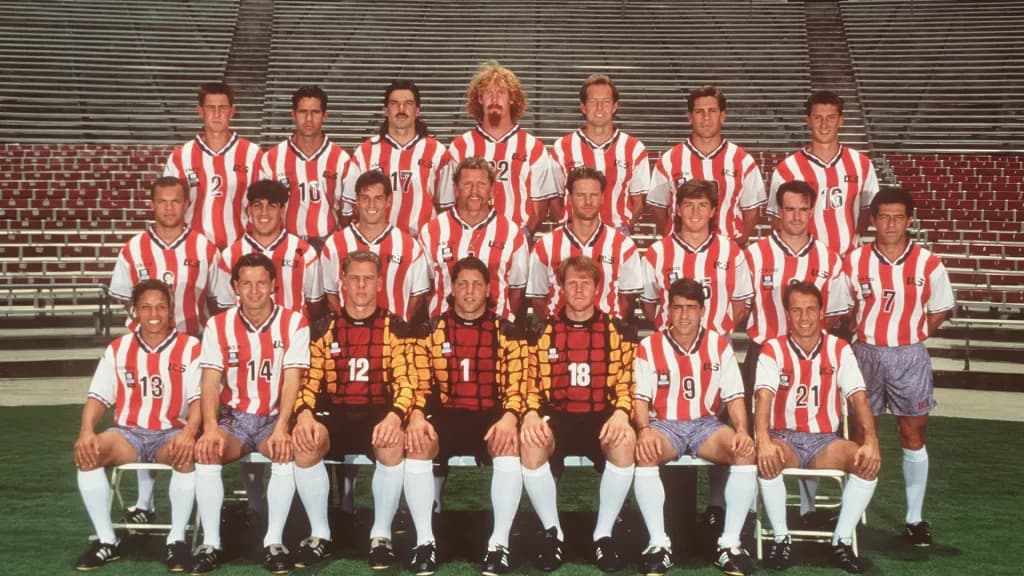
The last time the United States hosted the World Cup, it shattered every record in sight. 3.5 million fans came through the gates, and though the U.S. (AKA the USMNT) lost to the eventual World Cup winner – Brazil – it sparked an affection for the beautiful game that can be felt today.
Now it’s 2026; Major League Soccer (MLS) continues to grow, and the World Cup is back on American soil for the biggest tournament ever. But before Team USA faces Paraguay in their opening match, let’s reminisce about the first time they were the center of the soccer universe with this ‘94 World Cup Guide.
View the latest World Cup Odds!
Key Moments and Results from the 1994 World Cup
The 1994 FIFA World Cup wasn’t just another tournament. It was a turning point. At a time when soccer was still finding its place in the United States, the tournament delivered drama, passion, and record-breaking numbers that changed the game forever.
A total of 3,587,538 fans attended matches, making it the most-attended World Cup in history at the time. Stadiums were packed to around 96% capacity, with an average of 68,991 fans per match. That kind of turnout proved that the U.S. could host soccer on a massive scale.
On the field, the USMNT made history by reaching the Round of 16 for the first time since 1930. That run ultimately sparked a new level of interest in soccer across the country. They were ultimately eliminated by Brazil on July 4th.
Undoubtedly, it was a 1-0 loss against the greatest soccer nation in history. A loss to the team that went on to win the 1994 World Cup. A loss on Independence Day, in front of 11 million TV viewers (a record at the time). Needless to say, the effort left a lasting impression.
The tournament ended with a tense final between Brazil and Italy. After a 0-0 draw, Brazil won 3-2 in a penalty shootout, claiming their fourth World Cup title. It was the first World Cup final decided by shootout, adding to ‘94’s history.
With the 2026 World Cup Group Stage expanding from 32 teams to 48, these shocking/inspirational moments are about to be challenged again on U.S. soil – and the World Cup betting lines are already moving.
The Stadiums and Venues of the 1994 World Cup
Like the 2026 tournament, the 1994 FIFA World Cup stadium venues stretched across the United States, giving fans from coast to coast a chance to be part of the action. Nine venues hosted matches, each bringing its own energy and atmosphere.
The Rose Bowl in Pasadena, California, hosted the final and remains one of the most iconic venues in World Cup history. Giants Stadium in East Rutherford, New Jersey, was another key location, drawing massive crowds throughout the tournament.
Other venues include the Pontiac Silverdome in Michigan, Soldier Field in Chicago, the Cotton Bowl in Dallas, Foxboro Stadium in Massachusetts, Stanford Stadium in Palo Alto, the Citrus Bowl in Orlando, and RFK Stadium in Washington, D.C.
In 2026, the tournament expands to 16 host cities across the United States, Canada, and Mexico, making it the biggest World Cup ever. The U.S. cities include MetLife Stadium in East Rutherford, New Jersey, which will host the final; Mercedes-Benz Stadium in Atlanta; SoFi Stadium in Inglewood; AT&T Stadium in Arlington; NRG Stadium in Houston; Arrowhead Stadium in Kansas City; Lincoln Financial Field in Philadelphia; Lumen Field in Seattle; Levi’s Stadium in Santa Clara; Hard Rock Stadium in Miami Gardens; and Gillette Stadium in Foxborough.
The Legacy of ’94 – What It Did for U.S. Soccer
The 1994 FIFA World Cup legacy goes far beyond attendance records and memorable matches. It laid the foundation for the growth of soccer in the United States.
The tournament generated a surplus of around $50 million, which helped fund the U.S. Soccer Foundation. That investment supported youth programs, community initiatives, and the development of sport at every level. Grassroots participation in soccer surged in the years that followed; meanwhile, host cities benefited from stadium upgrades and improved training facilities.
Most importantly, the tournament’s success directly led to the launch of Major League Soccer in 1996. MLS became the backbone of professional soccer in the U.S., giving domestic players more opportunities and helping build a dedicated fanbase. Today, European superstars like Lionel Messi are even playing in the league.
Everything that’s been built since 1994 – the leagues, the fanbases, the infrastructure – leads to its return in 2026, with a surge of fandom and investment.
FAQ
What was the total attendance at the 1994 World Cup?
3,587,538 – a record at the time, averaging 68,991 per game.
Who won the 1994 World Cup?
Brazil beat Italy 3-2 on penalties after a 0-0 draw.
Where was the 1994 World Cup final held?
The Rose Bowl in Pasadena, California.
How many stadiums were used in 1994?
Nine, spread across the United States.
What was the legacy of ‘94 for U.S. soccer?
It funded the U.S. Soccer Foundation, upgraded facilities nationwide, and ushered in the launch of MLS in 1996.
When is the next World Cup in the U.S.?
In 2026, the first U.S. match will be on June 13. It’s already shaping up to break every record ‘94 set.
Sign up to Bovada today.
The 2026 World Cup is coming. The teams are set, the cities are ready, and the odds are live. Don’t just watch history – bet on it. Place your World Cup bets at Bovada.
Bovada covers thousands of global sporting events and gives new players two exciting Welcome Bonus options – perfect for Soccer fans. Deposit with card and get 50% match up to $250, or go bigger with crypto and receive a 75% match up to $750 on your first deposit.
Put your bonus to work on World Cup action all season long – betting on moneylines, run lines, totals, player props, parlays, futures, and more. Whether you’re backing your favorite team or getting value on daily matchups, you’ll be ready to jump in from the first pitch.