
To research player props for events such as March Madness, the NFL, and the NBA, it’s best to understand what they are and how they differ from standard sports bets.
A player prop is where fantasy sports and sports betting meet. Rather than betting on an entire team to cover a point spread, these are bets on a player’s individual performance. These bets focus on whether a player goes over or under a statistical benchmark in a game or series.
Players can have fun by betting with their gut, but the best path to long-term success is researching the trends and stats of each prop to make informed decisions.
To help become a savvy prop bettor, we offer this player prop betting overview to make smarter betting decisions.
View the latest Odds at Bovada
What Does It Mean to Research Player Props?

Player props are wagers on a player’s statistical performance in a game. In an event like the NCAA basketball’s March Madness tournament, some of the props sportsbooks offer are whether a player will go over or under a certain number of points, rebounds, and assists.
Unfortunately, oddsmakers usually offer odds that provide balanced action. Player props are usually based on a myriad of factors, including a player’s average statistical output, the opponent they’re facing, and other mitigating factors such as playing at home or away, fatigue, and injuries.
Freshman forward Cameron Boozer currently averages 22.6 points for the Duke Blue Devils. Oddsmakers might look at those averages and post a player prop on whether he’ll go over or under 21 points one night or over and under 24 points on another. Understanding why a prop total is set at a specific number – and using that insight to guide your decision – is what makes player prop research so valuable.
Props can also get more complex, such as betting on his rebounds, assists, field goals made, or even a total that combines all three. To make these props even more lucrative, Bovada allows you to combine several player props on a game; these are known as same-game parlays.
Step-by-Step Guide: How to Research Player Props Effectively
Analyze Recent Player Performance Trends

Start with season averages as a baseline, then focus on the last 5-10 games to evaluate recent performance, role, minutes, and momentum shifts. For March Madness bets or NBA props, true shooting percentage (TS%) is also a key metric to analyze because it reflects a player’s scoring efficiency.
TS% is an advanced scoring stat available on sites like Sports-Reference.com. It measures a player’s overall scoring efficiency, accounting for field goals, three-pointers, and free throws. This matters because volume alone doesn’t cash overs – efficiency does.
For NCAA basketball, TS% typically averages around 54-56%, rises above 60% for elite scorers, and falls below 50% for inefficient players. This matters because a player averaging 19 PPG with a 48% TS%, high shot volume, and few free throws may be benefiting from a short hot streak – making regression more likely. Meanwhile, a player with a 61% TS% and a strong free-throw rate is typically scoring more efficiently and consistently, especially late in games.
Evaluate Matchups and Context
There are other stats to consider that dive even deeper. Players should look at matchups and context to make an informed judgment across a multitude of player prop betting types. This is especially effective if you’re placing head-to-head props where two players are directly matched up, or someone is facing a top defense.
Useful stats include Opponent Defensive Efficiency vs. Position, which measures how well defenses perform against players at a specific position. Player splits can also reveal how performance changes based on venue – an important factor during the NCAA Tournament, when games are played on neutral courts. Pace-of-play metrics are also valuable, since faster teams create more possessions and therefore more scoring opportunities.
Monitor Injury Reports and Lineup Changes
One of the larger player prop betting challenges is injuries that lead to a player’s absence. For example, the Golden State Warriors losing guard Stephen Curry through February indirectly affected Draymond Green. His points per game declined, and his field goal percentage dipped from 40% to 38%.
Injuries or lineup changes can significantly impact a player prop. Check how a player has performed in similar situations to see whether usage rises or falls, and monitor injury reports right up to tip-off, as players can sometimes be ruled out late during warmups or rest on back-to-back games.
Track Betting Line Movements and Alternative Lines

There’s a long-standing rule in advanced betting circles: bettors should compare multiple player prop betting markets to find the best odds. Bovada is known for balanced player props and strong oddsmaking, but those lines can also serve as a benchmark for spotting market inefficiencies at other sportsbooks.
Sharp bettors regularly compare props across sportsbooks to find the total that best fits their over/under wager. Even a half-point difference can matter once the games begin. It’s also worth monitoring how public money shifts odds; heavy support for star players can sometimes push totals higher, creating value on the under.
Finally, don’t overlook alternative lines. While the range of options and varying juice can seem overwhelming, they can offer value for bettors who have identified a specific statistical outcome through careful research.
Practice Proper Bankroll Management
Even the most thorough player prop betting research cannot eliminate volatility. Player props carry high variance because they depend on individual performances that can shift quickly due to game flow, coaching decisions, foul trouble, or injuries. Even a well-researched prop can miss if a player logs fewer minutes or a game turns into a blowout.
That’s why proper bankroll management is essential. Many experienced bettors use percentage-based staking, risking about 1%–3% of their bankroll per wager to protect against losing streaks and maintain discipline over time.
It’s also important to avoid chasing losses. Increasing bet size after a loss often leads to bigger mistakes and unnecessary risk. Instead, stick to a consistent staking plan and treat each bet as part of a long-term strategy.
View the Latest Odds at Bovada!
Sources and Data for Player Prop Research
Successful player prop betting research relies on reliable statistics and trusted analytics. Rather than relying on basic box scores, bettors should focus on advanced metrics that reveal player efficiency and matchup advantages. Using quality data sites can help identify trends and patterns that sportsbooks may not fully price into prop bets.
Below are several resources by sport, along with one key metric worth focusing on.
- NBA/NCAA Basketball: Sports-Reference
One of the most comprehensive basketball databases available. True Shooting Percentage (TS%) is the stat to focus on, which measures scoring efficiency by accounting for field goals, three-pointers, and free throws. TS% provides a clearer picture of a player’s scoring impact than basic shooting percentages. - NFL/College Football: Pro Football Reference
A major data hub for football analytics. When researching player props, focus on Target Share, which measures how often a receiver is targeted on offense. This helps project receiving yards and receptions more accurately. - MLB: FanGraphs
FanGraphs offers advanced baseball analytics beyond traditional stats. A key metric to evaluate is wOBA (Weighted On-Base Average), which measures a hitter’s overall offensive value and is useful when analyzing total base or hitting props.
Using multiple sources and focusing on advanced metrics can provide deeper insight into player performance and improve prop betting research.
Key Strategies for Player Prop Research
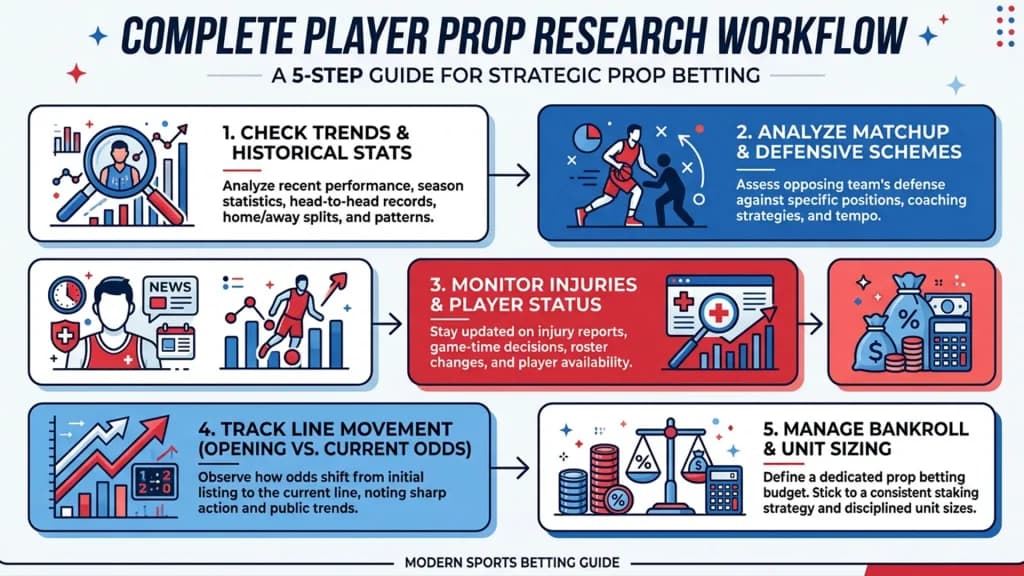
Effective player prop betting comes from building a structured and pragmatic process rather than relying on isolated stats. The most successful bettors evaluate multiple factors and look for value where oddsmakers may missed valuable context.
A few strategic principles can help guide prop research:
- Focus on value, not predictions
The goal is not to guess whether a player will go over or under, but to determine whether the sportsbook’s line reflects the player’s expected performance. - Compare projections to sportsbook odds
Advanced bettors use tools such as an NBA prop bet analyzer to compare projected stats against sportsbook odds. This highlights props where the market may be mispriced. - Use analytics to support decision-making
Modern research often uses statistical models or player prop betting AI to analyze trends and probabilities, helping bettors evaluate props more objectively.
Common Challenges and Mistakes When Researching Player Props
Even with solid analysis, several common player prop betting challenges can lead to bad decisions if bettors are not careful.
One common mistake is blindly betting on star players. Their props are usually inflated by heavy public action. Another is ignoring game context, such as pace, defensive matchups, or projected minutes, which can heavily influence whether a player reaches a statistical milestone.
Bettors also miss when they ignore late injury updates or lineup changes, which can quickly shift player usage and prop value.
Finally, it’s important to remember that even well-researched bets can miss due to foul trouble, coaching adjustments, or unexpected game flow.
Player Prop Research FAQ
What is the most important factor when researching player props?
Advanced, efficiency stats from the last 5-10 games often provide a great snapshot of a player’s current role, their minutes, usage, and whether their production is consistent.
How far back should you analyze player stats?
Most player prop betting research focuses on the previous 5–10 games to identify meaningful trends.
Which statistics matter most for player props?
Advanced metrics such as true shooting percentage, usage rate, and potential assists often provide better insight than per-game averages.
Does line movement matter when researching props?
Yes. Sudden line movement can indicate new information such as injuries, lineup changes, or sharp betting activity.
Should you combine player props in parlays?
Parlaying player props can increase potential payouts and create the opportunity for a bigger win. However, if just one selection loses, the entire parlay loses as well, making parlays significantly riskier than placing individual props.